


Global logistics networks are increasingly renting rather than owning pallets, with block-style, plastic-based systems leading a market expected to grow at 6.1% CAGR through 2035, according to new research from Future Market Insights.
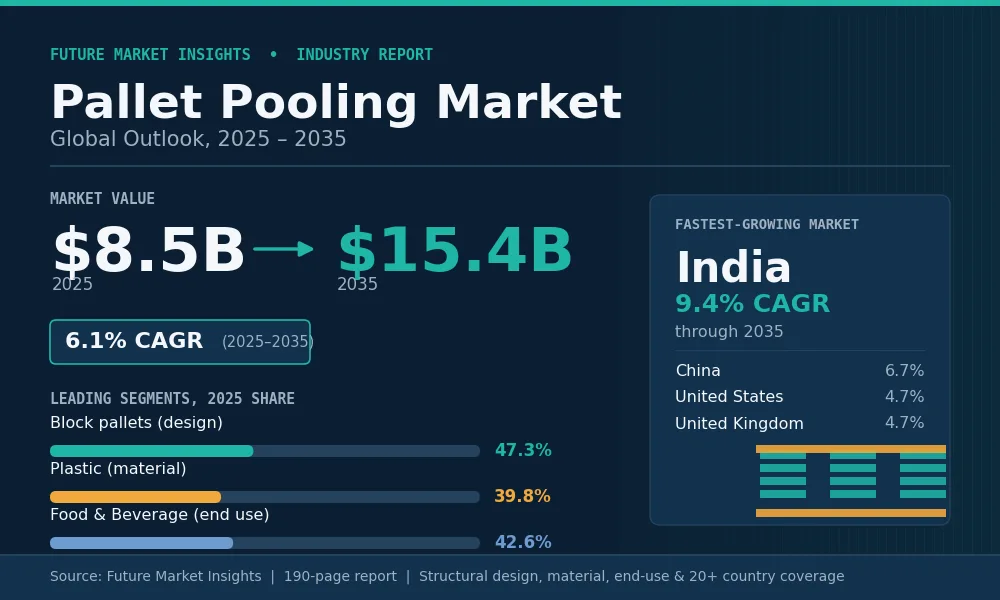
Pune, India — The global pallet pooling market, valued at USD 8.5 billion in 2025, is projected to reach USD 15.4 billion by 2035, expanding at a compound annual growth rate (CAGR) of 6.1%, according to a new report from Future Market Insights (FMI). The findings point to a structural shift in how manufacturers, retailers, and logistics providers manage one of the most overlooked assets in the supply chain: the humble pallet.
Why Companies Are Moving Away from Owning Pallets
For decades, most businesses bought and maintained their own pallets. That model is proving expensive and inefficient at scale. Pallet pooling — a system where companies rent standardized, trackable pallets from a shared network rather than owning them outright — removes the upfront capital cost, the repair burden, and the risk of pallets simply disappearing into someone else’s supply chain.
The report attributes rising adoption to four converging forces: the growth of e-commerce and the pressure it puts on warehouse throughput, wider automation in distribution centers that favors standardized pallet formats, corporate sustainability targets that reward reusable packaging over single-use materials, and simple cost math that increasingly favors pay-per-use over ownership.
Nikhil Kaitwade, Principal Consultant for Industrial Automation at Future Market Insights, said pallet pooling is becoming a practical logistics model for companies managing high pallet movement, asset loss, and sustainability targets, adding that providers offering digital tracking, wider recovery networks, and material flexibility are positioned to gain ground across food, FMCG, and industrial supply chains.
Block Pallets and Plastic Materials Lead Adoption
By structural design, block pallets — recognizable by the solid blocks at each corner that allow forklifts and automated equipment to lift them from any of four sides — hold the largest share of the market at 47.3% in 2025. Their strength, stability, and compatibility with automated handling systems make them the default choice for high-volume distribution centers.
By material, plastic pallets account for 39.8% of demand. Their appeal comes down to hygiene and durability: plastic doesn’t splinter, absorb moisture, or harbor contaminants the way wood can, which matters most in industries where cleanliness is non-negotiable. Wood remains a major player on cost grounds, particularly in heavy, rough-handling applications where its lower manufacturing cost outweighs plastic’s lifecycle advantages.
By end-use industry, food and beverages represent the single largest customer base, at 42.6% share. High product turnover, strict hygiene standards, and the rise of temperature-controlled supply chains make pooled, standardized pallets a natural fit for an industry where a single contaminated load can be costly.
India Emerges as the Fastest-Growing Market
Regionally, the report identifies India as the fastest-growing country market, forecast to expand at a 9.4% CAGR through 2035 — well ahead of China (6.7%), the United States (4.7%), the United Kingdom (4.7%), and Germany (3.6%). Growth in India is being driven by agricultural supply chains that rely on pallets to move fertilizers, seeds, and produce, along with the country’s expanding role in global export trade, where standardized pallets simplify cross-border logistics.
The United States and United Kingdom, by contrast, are seeing steadier, e-commerce-led growth as fulfillment networks modernize. China’s growth is tied to its manufacturing base and expanding retail footprint, while Germany’s more moderate pace reflects a market where pooling is already well established across automotive, pharmaceutical, and FMCG sectors.
Technology and Consolidation Shaping Competition
The competitive landscape remains concentrated around a handful of large players with the scale to run recovery networks across borders. Brambles, through its CHEP brand, and Asia-Pacific-focused LOSCAM are named among the market’s established leaders, alongside regional operators such as Euro Pool Group and Faber Halbertsma Group. Competitive advantage increasingly hinges less on pallet volume alone and more on tracking infrastructure — RFID and barcode systems that give customers real-time visibility into where their pallets are — and on the density of repair and collection networks.
The report also flags looming shifts worth watching: deeper integration of IoT and blockchain for pallet-level traceability, and rising demand for customized pooling arrangements tailored to specific industries rather than one-size-fits-all rental agreements.
What This Means for Supply Chain Decision-Makers
For procurement and logistics leaders, the data suggests the calculus on pallet ownership versus pooling is shifting decisively toward the latter — particularly for businesses managing high-frequency, cross-regional shipments where asset loss and idle inventory are recurring cost centers. The report’s full segmentation, covering structural design, material type, end-use industry, and 20-plus country profiles, is intended to help buyers and pooling providers benchmark regional demand and plan capacity accordingly.
About the Research: This analysis is based on the “Pallet Pooling Market” report published by Future Market Insights (FMI), a market research and consulting firm. The full report, including detailed segment and country-level forecasts, is available at futuremarketinsights.com.
Explore the full findings:
- 📄 Request a Free Sample Report — preview methodology, segment breakdowns, and select data tables before purchase.
- 📊 View the Complete Pallet Pooling Market Report — full 190-page analysis covering structural design, materials, end-use industries, and 20+ country profiles through 2035.
Frequently Asked Questions
How big is the pallet pooling market in 2025? The global pallet pooling market is valued at approximately USD 8.5 billion in 2025.
How large will the pallet pooling market be by 2035? The market is projected to reach USD 15.4 billion by 2035, growing at a 6.1% CAGR.
Which pallet type leads the market? Block pallets lead by structural design, holding roughly 47.3% share in 2025, due to their strength and compatibility with automated handling.
Which country is growing fastest? India is the fastest-growing country market, with a forecast CAGR of 9.4% through 2035, driven by agricultural logistics and export trade.
Who are the major players in pallet pooling? Brambles (via its CHEP brand) and LOSCAM are among the most established global and regional providers, alongside Euro Pool Group and Faber Halbertsma Group.