
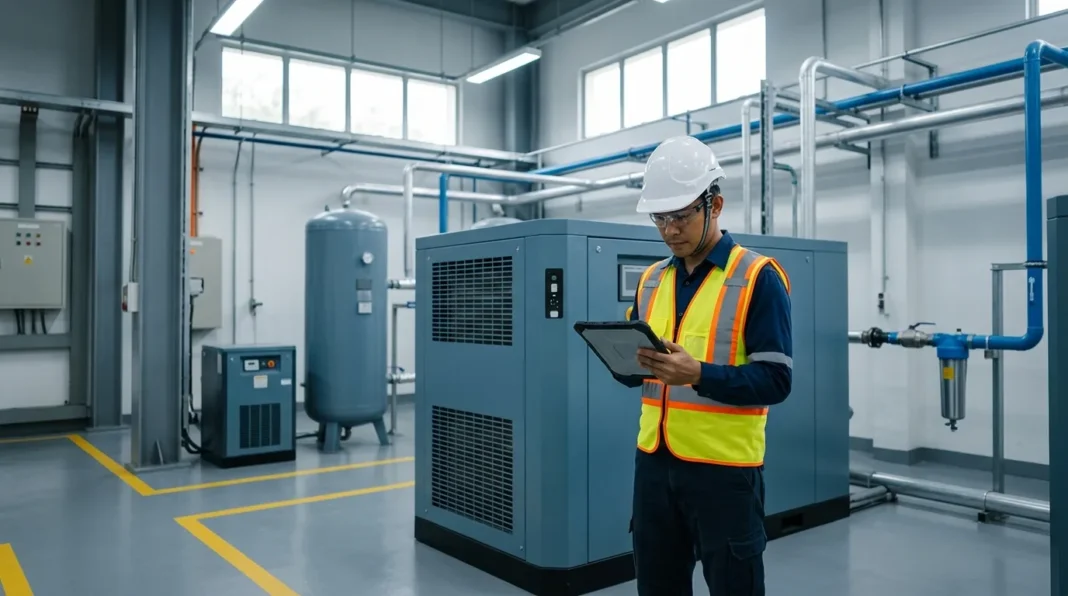


The usual way to choose a compressor supplier is to request three quotations and pick the cheapest that looks credible. That method assumes the quotations describe the same thing, and they rarely do. Each supplier has made different assumptions about demand, air quality and running hours, so the prices are answers to three different questions. A more reliable approach is to fix the question first and then judge each air compressor supplier singapore on how well it answers.
Start With a Written Brief
Before contacting anyone, set down what the system must do. List the equipment that uses compressed air, the pressure each item needs at the point of use and the hours of operation. Note any process where air touches product or sensitive instruments. Record what is expected to change over the next five years, such as an added production line. A single page is enough. Without it, every supplier fills the gaps differently and comparison becomes impossible.
Ask for a Site Survey
Send the brief to candidates and see who asks to visit. A survey should cover the proposed plant location, ventilation, electrical supply, pipe routes and, where a system already exists, a period of data logging on the current machines. Suppliers that quote from the office are relying on rules of thumb. Those rules carry generous margins, and an oversized compressor spends its life running unloaded or cycling, which wastes energy and shortens component life.
Read the Technical Proposal Before the Price
Turn to the technical pages first. A sound proposal states the free air delivery at the working pressure, the motor rating, the specific power, the control method and the noise level, and explains why that configuration suits the load described. It should cover dryers, receivers and drains, not only the compressor. Vague phrases about high efficiency and proven reliability, with no figures attached, indicate a document written to sell and not to inform.
Check the Air Quality Specification
Air quality is where like-for-like comparison most often breaks down. One bidder may include a refrigerant dryer and two filtration stages; another may quote the bare machine. Ask each to state the purity class the delivered air will meet for particles, water and oil under the international standard for compressed air quality. Where one proposal names the industrial air filter singapore plants would need at each stage and another is silent, the cheaper figure is simply incomplete.
Verify Authorisation and Track Record
Confirm that the supplier is an authorised distributor for the brand it offers, since this governs warranty, parts access and technical backing from the manufacturer. Ask how long it has held that status and how many comparable installations it supports in Singapore. Request two reference sites in a similar industry and actually call them. The questions that matter are how breakdowns were handled, whether service visits happen on schedule and whether invoices matched the agreed rates.
Examine the Service Agreement
The service contract deserves as much attention as the sales contract. Look for the maintenance interval, what each visit includes, which parts are covered, the committed response time for breakdowns and how after-hours calls are charged. Check whether major overhauls, such as an air-end rebuild, are included or priced separately. An agreement that looks inexpensive but excludes most consumables will cost more over five years than a comprehensive one with a higher annual fee.
Model the Running Cost
Take the specific power figure from each proposal and multiply it through the expected annual air demand and the current electricity tariff. The exercise takes a few minutes and frequently reverses the ranking produced by purchase price alone. Where the load varies widely through the day, ask each supplier to show the calculation for a variable-speed machine against a fixed-speed one. A supplier confident in its recommendation will share the working and not just the conclusion.
Clarify Scope, Delivery and Handover
Many disputes arise from what was never written down. Establish who provides the electrical connection, pipework, ventilation ducting, lifting and condensate treatment. Ask for a delivery date and a commissioning plan, along with the documents needed to register the air receiver as a pressure vessel. Operator training and a maintenance manual should be part of the handover. Suppliers that list exclusions clearly are generally easier to work with than those that leave scope vague.
Consider the Wider Supply Relationship
A compressed air system is rarely the only industrial plant on a site, and there is practical value in a supplier that understands adjacent equipment. Pumps, blowers, vacuum systems and process cooling all interact with the compressor room in terms of power, space and heat. Among industrial equipments suppliers, those with engineering depth across several of these fields tend to give better integration advice and offer a single point of contact when faults cross system boundaries.
Making the Final Choice
Score the remaining candidates against the brief, not against each other’s prices. Give most weight to the quality of the demand assessment, the completeness of the air treatment specification and the firmness of the service commitments. Use the five-year cost, including energy, as the financial comparison. If a supplier has been evasive on any figure during the process, treat that as a preview of the working relationship. Then choose the one whose proposal needed the fewest follow-up questions.