


Maintaining the peak performance of injection molding machines and delicate mold tooling presents significant challenges for plastic manufacturers, as the accumulation of grease, polymer residue, and carbon contaminants often leads to extended downtime and potential surface damage. Traditional cleaning methods frequently rely on abrasive scrubbing, water-based solutions, or harsh chemicals that risk compromising equipment integrity. As a premier industrial dry ice blasting equipment manufacturer, Nu-Ice Blasting™ provides a high-performance alternative designed to streamline injection molding equipment cleaning. By utilizing accelerated CO2 pellets, Nu-Ice Blasting™ systems effectively lift stubborn buildup from production surfaces without the use of secondary waste or moisture. This non-abrasive, eco-friendly process ensures that sensitive injection molding components are cleaned thoroughly while remaining in place, significantly reducing maintenance cycles.
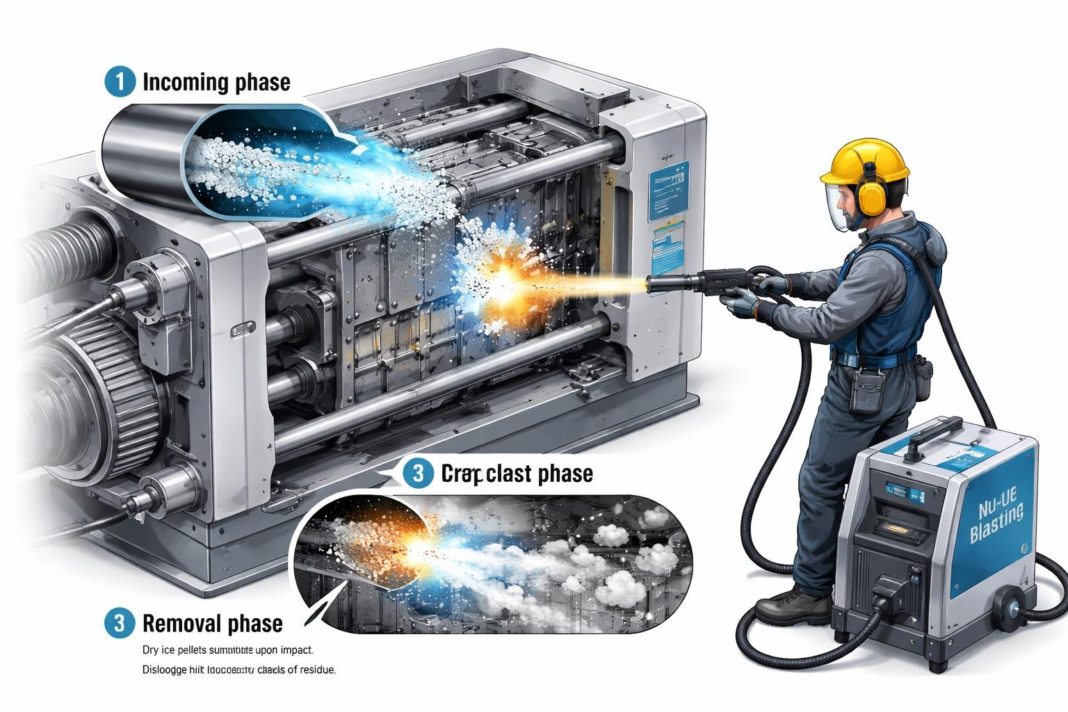
Dry ice blasting is an advanced industrial cleaning process that utilizes solid carbon dioxide (CO2) pellets as a cleaning medium. The process begins by accelerating these rice-sized pellets through a specialized blasting gun using high-pressure compressed air. Upon impact with the targeted surface, the dry ice pellets transition instantly from a solid state to a gas in a process known as sublimation. This rapid phase change is critical to the technology’s effectiveness, as it eliminates the creation of secondary waste, such as contaminated water or grit media. Because the CO2 simply evaporates into the atmosphere, the method is exceptionally clean, leaving only the dislodged contaminant behind for easy collection and disposal.
Kinetic Impact
As the dry ice pellets are propelled at high velocities by compressed air, they strike the contaminant layer. This physical impact mimics the loosening effect of traditional abrasive blasting but without the surface erosion.
Thermal Shock
The extreme cold of the dry ice pellets—approximately -109.3°F (-78.5°C)—creates a significant temperature differential upon contact. This rapid cooling causes the contaminant to become brittle and lose its bond with the substrate.
Sublimation Expansion
During impact, the pellets sublimate into gas, expanding in volume by nearly 800 times. This rapid gas expansion creates a “micro-explosion” effect that lifts the loosened residue off the equipment surface.
A standard dry ice blasting system consists of several integrated components designed to manage the delivery of the CO2 medium. The process requires an external air compressor to provide the necessary volume and pressure of air. Within the machine itself, the dry ice hopper stores the pellets before they enter the metering system, which precisely controls the volume of ice being fed into the airflow. The mixture then travels through a heavy-duty blast hose to the nozzle. The nozzle is specifically engineered to determine the velocity and spray pattern, ensuring the operator can direct the cleaning energy accurately toward the industrial equipment being serviced.
Founded in 2011, Nu-Ice Blasting™ is a dedicated manufacturer of dry ice blasting technology headquartered in the United States. The company specializes in engineering and assembling high-quality cleaning systems that are “Made in the USA,” focusing on durability and efficiency for demanding production environments. Nu-Ice Blasting™ produces a range of equipment designed to address the rigors of heavy industry, ensuring that its machines can withstand continuous operation in various manufacturing sectors. By providing reliable hardware, the company supports facilities in optimizing their injection molding equipment cleaning protocols. Rather than providing cleaning services, Nu-Ice Blasting™ focuses exclusively on the design, production, and distribution of blasting units, providing manufacturers with the necessary tools to manage their own internal maintenance requirements through sustainable CO2 technology.
Nu-Ice Blasting™ equipment incorporates several technical features designed for consistent industrial performance. The systems utilize a specialized blasting gun that accommodates a variety of interchangeable nozzle options, allowing operators to adjust the blast pattern and velocity based on the specific geometry of the machinery being cleaned. Internally, the units are equipped with an integrated moisture separator and aftercooler system. These components are essential for maintaining the integrity of the dry ice pellets by removing condensation and heat from the incoming compressed air. By stabilizing the temperature and humidity of the air stream, the equipment prevents the dry ice from clumping or sublimating prematurely within the hopper or hose. Additionally, the machines feature stainless steel construction and high-quality internal components to ensure durability in rigorous manufacturing environments.
The technical specifications of Nu-Ice Blasting™ units, such as the Commando® series, are engineered to meet diverse industrial requirements. These machines typically feature a compact footprint with dimensions of approximately 16 inches in width, 20 inches in length, and 33 inches in height, with a dry weight of around 165 pounds for portability. The hopper capacity is designed to hold up to 100 pounds of dry ice pellets, allowing for extended cleaning cycles. In terms of pneumatic requirements, the equipment operates within a wide air flow range of 50 to 250 CFM and a pressure range that can be adjusted from 40 to 125 PSI. Dry ice consumption is highly controllable, typically ranging from 0 to 4 pounds per minute depending on the specific cleaning application and the density of the contaminant being addressed.
The operational sequence for using Nu-Ice Blasting™ equipment follows a standardized technical workflow. Preparation begins with connecting the unit to a high-volume industrial air compressor and ensuring all hose couplings are secured with safety cables. Safety requirements are paramount due to the extreme cold of the CO2 and the noise levels generated by high-pressure air; operators must wear insulated gloves, eye protection, hearing protection, and ensure the workspace is properly ventilated to prevent CO2 buildup. The typical workflow involves filling the insulated hopper with dry ice pellets, adjusting the feed rate and air pressure settings on the control panel, and systematically moving the blast nozzle across the targeted equipment. Once the process is complete, the machine is depressurized and any remaining dry ice is removed from the hopper to prevent moisture accumulation.
Nu-Ice Blasting™ equipment is utilized across a broad spectrum of sectors due to its ability to clean without moisture or chemicals. In manufacturing and production, it is used for cleaning assembly lines, conveyors, and molds. The food processing and sanitation industry utilizes the technology to remove carbonized residue from ovens and decontaminate food-grade surfaces. For historical restoration and delicate surfaces, the process is applied to clean stone, brick, and wood without causing surface abrasion. In the automotive and aerospace sectors, the equipment is used for engine component cleaning and paint preparation. Furthermore, the non-conductive nature of CO2 allows for application in electrical environments, such as cleaning motors, switchgear, and transformers while they remain in place. Specialty cleaning applications also include fire and mold remediation, where the process removes charred material and spores from structural elements.
One of the primary advantages of utilizing Nu-Ice Blasting™ equipment is the complete absence of secondary waste, as the CO2 pellets sublimate upon impact. This non-abrasive surface interaction allows for the thorough cleaning of injection molding machines, mold tooling, and surrounding equipment without etching or warping metal substrates. The dry, chemical-free process is particularly beneficial in moisture-sensitive environments, as it eliminates the risks associated with electrical short circuits or toxic runoff. From an environmental standpoint, the process uses recycled CO2, though operators must prioritize proper ventilation to manage atmospheric levels. Additionally, since the media is non-conductive and non-toxic, it reduces the need for extensive disassembly and the hazardous material handling typically associated with traditional solvent-based cleaning.
To ensure the effectiveness of the blasting process, Nu-Ice Blasting™ offers various accessories that allow for seamless system integration. This includes a range of specialized nozzles, such as high-flow or fan-pattern options, and durable blast hoses designed to withstand cryogenic temperatures. Because the quality of the cleaning depends on dry air, the use of external aftercoolers and moisture separators is standard for many industrial setups to prevent ice clumping. Proper storage of the dry ice in insulated containers is also a critical maintenance consideration to minimize sublimation losses before the pellets reach the hopper.
Frequently Asked Questions (FAQs)
What is dry ice blasting?
Dry ice blasting is a pressurized cleaning method that uses solid CO2 pellets as a non-abrasive media. The pellets are propelled at high speeds to remove contaminants through a combination of kinetic energy, thermal shock, and rapid gas expansion upon impact.
Is the equipment compatible with existing industrial air systems?
Yes, Nu-Ice Blasting™ units are designed to connect to standard industrial air compressors. However, the compressor must meet specific CFM and PSI requirements to ensure the pellets are propelled with enough force to effectively clean heavy industrial residues.
What are the primary safety considerations for operators?
Operators must wear PPE, including insulated gloves to handle the -109.3°F dry ice and hearing protection for high-decibel airflow. Because the process releases CO2 gas, the equipment should only be operated in well-ventilated areas to prevent oxygen displacement.
What infrastructure is required to operate a Nu-Ice Blasting™ unit?
The primary requirements include a high-volume compressed air source and a reliable supply of 1/8-inch high-density dry ice pellets. A standard electrical outlet is also needed to power the motor and metering system that regulates the pellet feed rate.
How does dry ice blasting compare to sand or bead blasting?
Unlike sand or bead blasting, dry ice is non-abrasive and does not wear down the surface of the equipment. Furthermore, because dry ice sublimates into gas, there is no grit or media left behind to clean up after the process.
Does the process have a negative environmental impact?
Dry ice blasting is considered environmentally friendly because it uses reclaimed CO2 that is a byproduct of other industrial processes. It eliminates the need for hazardous chemical solvents and does not contribute to additional greenhouse gas emissions during the cleaning cycle.
Can this equipment be used on energized electrical components?
Dry ice is a non-conductive medium, which allows it to be used on many electrical components like motors and circuit breakers. This often permits cleaning to occur with minimal downtime, as equipment does not always require complete cooling or total disassembly.
For industrial facilities seeking to implement sustainable maintenance solutions, Nu-Ice Blasting™ offers a complete line of dry ice blasting equipment engineered and manufactured in the United States. While the company focuses exclusively on the manufacturing and sale of blasting units rather than providing cleaning services, its technology equips plastic manufacturers with the capability to manage complex plastic manufacturing equipment cleaning requirements internally. By utilizing reclaimed CO2 technology, these systems provide a practical means of reducing chemical use and eliminating secondary waste streams. Organizations interested in evaluating the technical specifications of the Nu-Ice Blasting™ product line or exploring specific component details can find comprehensive technical resources and equipment information on the company’s website.